The Cucapá and the Fight for Their Land Rights
During the last five hundred years, western settlers and international corporations have eliminated, subjugated, or removed Native Americans from their ancestral lands to exploit natural resources (Dominguez and Luoma, 2020). Land dispossession is a critical component driven by colonization and capitalism reproduced by neoliberal conservation strategies (Rodríguez Goyes et al., 2019).
Mexico has followed suit with international conservation tendencies defined in the second half of the twentieth century. In 1993, the Mexican government established the Upper Gulf of California and Colorado River Delta Biosphere Reserve (Upper Gulf of California reserve) without consulting nor notifying the Cucapá tribe living within it, in the Colorado River basin. Some members of the Cucapá tribe suddenly found themselves living unlawfully in a land that has belonged to their ancestors for thousands of years.
The Cucapás felt the effects of land dispossession and fishing bans due to neoliberal conservation policies, which affected their livelihoods (Navarro Smith et al., 2014). Since then, the Cucapá fishers – most of whom are women – have been fighting for the government to recognize their traditional territorial rights, including their right to exploit natural resources. By establishing the Upper Gulf of California reserve, the Mexican government criminalized the Cucapá presence in the Colorado River basin and, consequently, the fight for their rights to access the land (Navarro Smith et al., 2014). It was not until recently that the Cucapás won some of the disputed rights, but not before fighting a long and expensive legal battle.
Building on the notion of conflict and equivalences as outlined by Fabiana Li in Unearthing Conflict: Corporate Mining, Activism, and Expertise in Peru (2015) and the practices and discourses of decolonization discussed by Silvia Rivera Cucicanqui in Chi'ixinakax Utxiwa: On Decolonizing Practices and Discourses (2020), I will explore what actions the Cucapás have taken to fight against the mandate of the Upper Gulf of California reserve imposed by the Mexican government. I am particularly interested in answering the questions, Do the Cucapás strategies to fight conservation policies differ from those practiced by other Latin American Indigenous communities fighting extractive systems? If so, How? By answering these questions through the lenses of Li's conflict and Rivera's decolonization concepts, I hope to understand the similarities between neoliberal conservation and extraction policies that disenfranchise Indigenous communities.
Land for Conservation
The uncontrollable extraction of natural resources worldwide has had severe social and environmental consequences. It was not until some countries acknowledged that corporations' activities – both private and state-owned – were causing rapid ecological degradation that they decided to act and started enacting protected areas (Dominguez and Luoma, 2020). Today, the term protected area covers many different categories that range from strict protection to those that allow the sustainable use of resources (Dudley et al., 2013). But in the nineteenth and twentieth centuries, states directed most of their conservation policies to preserve land, and in the case of degraded land, to their restoration. Much of the land designated by states as National Parks and Biosphere Reserves – among other protected area designations – overlaps with land traditionally managed by Native peoples. Consequently, the creation of protected areas effectively dispossessed Indigenous peoples from their lands (Rodríguez Goyes et al., 2019).
More recently, the commodification of conservation through the payment for ecosystem services – i.e., carbon credits and water trades – have pushed conservation policies beyond the reach of Native communities who don't have a seat at the negotiation table (Rea, 2015). Although during the last twenty years conservation discourses have moved towards recognizing Indigenous rights by including participatory models, the models have not integrated the perspectives of Indigenous peoples in the process, failing to achieve meaningful conservation goals (Fletcher, 2010).
Mexico decreed the first protected area, Desierto de Los Leones, in 1876. The Mexican government followed the Yellowstone model initiated in the US with the Yellowstone National Park's enacting in 1872. The Yellowstone model aims to preserve ecosystems in their pristine natural state, meaning that natural resources extraction was not allowed. During the 1930s, the Mexican government reinforced its conservation policies by enacting national parks and establishing fishing bans (Yáñez Mondragón, 2007; Rodríguez Goyes et al., 2019). Starting in the 1970s, the Mexican government focused on addressing pollution and human health issues and enacted policies centered on forest and wildlife management. In the 1980s, Mexico enacted laws and regulations and created the environment protection federal bureau, SEMARNAT. In the following decade, the advancement of rules and regulations was at full blast (Yáñez Mondragón, 2007).
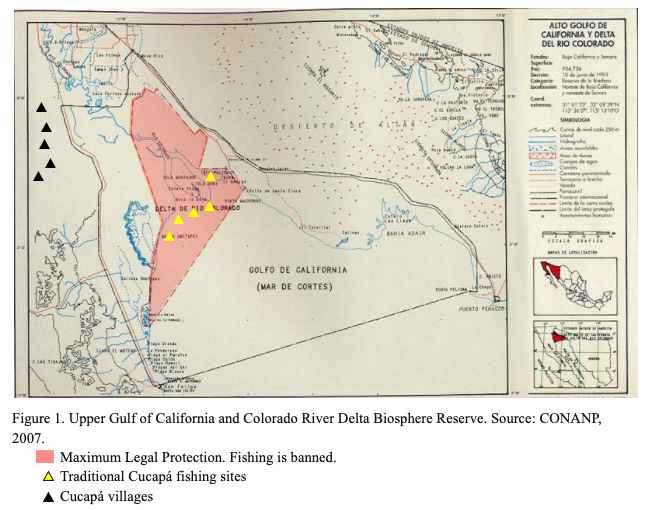
In 1993, SEMARNAT decreed the Upper Gulf of California reserve, incorporating land traditionally owned by the Cucapás in its 1,652,110 hectares (6,378.8 sq mi). The most substantial impact was a no-take zone (an area where the extraction of resources is prohibited) established within the reserve that displaced them and affected their livelihoods, mainly fishing. As of 2020, 17.5% of land and marine areas in Mexico are under some form of protection, most of which (80%) are on lands, rivers, and oceans administered by Indigenous peoples (Valle Rodríguez, 2006).
Several articles discuss cases in Mexico and Latin America that debate Indigenous lands' dispossession due to the establishment of protected areas from a legal perspective, including Beltrán (2001), Barragán Alvarado (2008), and Schmidt (2010). It is also essential to consider the Cucapá people's resistance strategies fighting for their land, livelihoods, and culture, in sum, their collective identity.
The Cucapá People in the Colorado River Delta, Mexico
The Cucapá Native Americans live in approximately twenty localities scattered in Baja California and Sonora, Mexico, and Arizona, US. According to the latest 2010 census, 1000 Cucapá resided in Arizona and 300 in Mexico (Martínez Coria and Haro Encinas, 2015). Historically, fishing in the Colorado River delta has played an essential socio-economic role within the Cucapás living in Mexico. In the last five decades, several fisheries, including subsistence fisheries such as totoaba (Totoaba macdonaldi) and corvina (Cynoscion othonopterus), have shown signs of overexploitation due to the uncontrollable issuance of fishing permits to non-Indigenous peoples by the Mexican government (Mora Reguera, 2016).
The collapse of the totoaba and corvina fisheries during the 1970s and 1980s led the Mexican government to establish a fisheries ban and enact the Upper Gulf of California reserve in 1993 (Mora Reguera, 2016; Navarro Smith, 2010). The reserve's management plan defined a no-take zone that overlapped with the traditional fishing sites of the Cucapá. The no-take zone turned the Cucapá ancestral presence in the Colorado River Delta into an illegal status (Navarro Smith et al., 2014). The Mexican government considered illegal any activity carried out by the Cucapás within the no-take zone of the reserve, including fishing, collecting wild fruits, and others (Figure 1). The Cucapá continued with their ancestral fishing activities confronting the Mexican authorities, who, in return, started jailing some of the fishers (Navarro Smith, 2013). The Cucapás mobilization started once they realized they were unlawfully fishing in their ancestral land.
Navarro Smith et al. (2014) narrate how during the 2014 fishing season, the friction between Cucapá fishers and Mexican authorities worsened. With a banner that read "Respeto por la Pesca Cucapá" (Respect for the Cucapá fishing) and temperatures above 100 degrees Fahrenheit, Cucapá fishers blocked a federal highway with their boats. They used the demonstrations to pressure authorities to issue the official documentation necessary for selling more than 40 tons of Corvina they caught. The government argued the Cucapá fishers exceeded the legal fishing quota for the season and refused to issue the documents. The Cucapá endured pressure from government officials and angry drivers but persisted until the fishing officials handed them the papers two days later, before lifting the blockade. Local and national media covering the demonstration presented the conflict between fishers and government officials as two irreconcilable positions. On the one hand, the Cucapás demanding the recognition of their right to fish, and on the other, the Mexican authorities applying the rule of law (Navarro Smith, 2013; Navarro Smith et al., 2014).
Understanding the Conflict
To better understand the underlying foundations of the dispute between Cucapás and Mexican authorities, I want to introduce the concept of conflict, as Fabiana Li (2015) stated. Based on her experiences in the mining conflict in Peru, Fabiana Li reconceives the idea of conflict and opens it up to include the complex relationships and experiences by people, places, and nonhumans.
When analyzing the actors involved in the Cucapá conflict, I was able to identify six main groups.
- The Cucapá. They centered their fight for the state to recognize their ancestral territorial rights and respect their traditional food systems.
- A conservationist group. It is a group that helped implement the conservation policies and saw the conflict from a legal perspective, including lawmakers, academics, scientists, government officials, and international non-profit organizations.
- An advocates group. A smaller group of actors, including lawyers and local NGOs, focused on defending the Cucapá's rights to tribal consultation.
- A group of non-indigenous fishers from the region. They saw the Cucapá as equals only in legal fishing terms.
- The media. National and regional newspapers and broadcast news did not know much of the Cucapá people or the conflict.
- And the rest of society.
The Cucapás initiated their fight because they felt the reserve's enactment threatened their livelihood, mainly fishing. After the advocate group approached and allied them, the Cucapá started making demands for their rights to tribal consultation. They demanded their right to remain in their ancestral territory, exploit their natural resources, and retain their cultural identity, including fishing as a critical component. The Cucapás started using technical words such as legislative measures, public policy, and productive projects. They based their claims on the agreement of the Indigenous and Tribal Peoples Convention of 1989. They were aware the government had violated their rights (Navarro Smith et al., 2010; Navarro Smith et al., 2014).
The Mexican authorities also changed their perspectives about conservation regulations. The Mexican government decided to conduct a tribal consultation after being pressured by the advocates' group. At first, the government was reluctant, insisting they conducted the public consultations established by law previous to enacting the reserve. The Cucapá argued the Mexican authorities did not consult the Cucapá fisher tribal leaders, but the Cucapá living in the nearby localities, who are not fishers, and not considered part of their clan. (Navarro Smith et al., 2010).
Non-Indigenous fishers felt the Cucapá fishers received special treatment by the Mexican authorities, who gave the Cucapá permits during the closed fishing season to ease the confrontation. After consulting the conservationist group, the government decided to give the special fishing permits, which gave them the green light after heated discussions. The rest of the society was divided about the conflict and would change their viewpoints depending on what they read or got from the media (Navarro Smith et al., 2010; Navarro Smith et al., 2014).
The actors constructed their narratives according to their knowledge and available information on the conflict. Their alliances and narratives changed before, during, and after the Cucapá blockade and the government's negotiations. The example is similar to Li's mine extraction in Peru, where she shows the complex, often fragile alliances between groups that do not have similar ideologies. As Li suggests, "Conflict needs to be understood as a set of relations - and not simply in terms of rupture" (Li, 2015, p 179).
The Concept of Equivalences
Another concept brought by Fabiana Li (2015) that is critical to understand the complicated relationships between actors is equivalences. The author used equivalences to analyze the different ways actors evaluated and compared the mines' social, economic, and environmental impact in Peru's mining. Even though Li talks about equivalences for the same resource, water, I believe the Mexican government's proposal to promote ecotourism as an economical alternative to fishing falls within Fabiana Li's equivalence concept (Li, 2015, p 23).
In Fabiana Li's piece, the mine considered water acceptable when meeting the environmental requirements' quality and quantity indicators. For the peasants, the treated water the mining company returned to the canals did not adequately compensate for the water they lost – neither in quality nor quantity. "The fact that the water was clean did not mean it was the same water, and hence [the peasants] required additional compensation" (Li talking about a peasant's perspective on water delivered by the mine. Li, 2015, p 168). However, the additional compensation was not enough. Peasants were negotiating a compensation package but felt it was worthless without the proper water quality (Li, p 170). Similarly, for the Cucapá, the possible loss of their ancestral fishing activities was a no-deal at the negotiation table.
Mexican authorities established a complicated compensation program to make up for the loss of income for fishing. The program included monetary compensation, training, and funds to transition to alternative economic activities outside the no-fishing zone, mainly ecotourism (CONANP, 2007). The Cucapá quickly valued their fishing income loss in financial terms but rejected the proposal to join in ecotourism activities. They argued that being Cucapá makes them a fisher, affirming their relationship with land and nature. Cucapás asserted that if an individual leaves the Colorado River Delta, the link with the community, the ocean, and the land weakens, even when temporarily returning to fish for corvinas (Navarro Smith et al., 2014). Cucapás' relationship to their landscape goes beyond utilitarian value and did not accept the government's offer.
Decolonizing Practices
When the government established the Upper Gulf of California reserve, they did it according to the western idea of conservation. Government officials and scientists decided, without consultation, which areas to keep out of human intervention. The Upper Gulf of California reserve management plan defines the no-take zone as an "area in which any type of extractive exploitation or changes in land use is not allowed. The only permissible land use is for ecotourism or low impact tourism activities, environmental education, research and monitoring, restoration, and pest control actions" (CONANP, 2007, p 133). The establishment of the reserve resulted in socio-economic devastation for the Cucapá. Concepts such as community rights and consultations intertwine in Cucapá politics, culture, and kinship (Navarro Smith et al., 2014).
In advocating for the Cucapá, I would like to examine the decolonization concept introduced by Silvia Rivera Cucicanqui (2020). Rivera shows us how the Bolivian elites use the practice of conditional inclusion, "a mitigated and second class citizenship," to reinforce their power (Rivera, 2020, p 50). By tagging Indigenous communities as minorities, the elites affirm and recognize some of them but obscure and exclude others. When the Bolivian government adopted a new rhetoric/discourse regarding Indigenous peoples as "original people," they denied "the contemporaneity of these populations." These narratives entrapped them in "stereotypes of the noble savage and as guardians of nature" (Rivera Cucicanqui, 2020, p 52-53). Like the Aymara in Bolivia, the Cucapá are stereotyped by the Mexican government, the non-Indigenous fishers, and the Mexican society in general. However, the Cucapá is a society that lives under ancestral beliefs that don't' impede them from adopting modern tools such as motorboats and nylon fishnets into their fishing practices. They have established fishing monitoring systems (Navarro Smith et al., 2010; Navarro Smith et al., 2014).
We could see the Cucapá fighting for their right to fish and access to their traditional land under the lens of the Katari-Amaru rebellion, which Rivera described as "the expression of indigenous modernity in which religious and political self-determination signified a retaking of their own historicity - a decolonization of imaginaries and of the forms of representation," which demonstrates that they "are, above all, contemporary beings and peers" (Rivera Cucicanqui, 2020, p 47-48). Contemporary indeed since they have adapted to the new market economies, and some fishers export their product. (Navarro Smith et al., 2010; Navarro Smith et al., 2014). The original people's narrative is, as Rivera mentions, about power.
For Navarro Smith et al. (2014), the conflict occurs when we leave the human element out of the analysis. The Mexican government and the conservationist group of scientists and officials do not consider the Cucapá communities located in the Upper Gulf of California reserve as part of the ecosystem. In particular, this case highlights neoliberal ways by which the state dispossesses the Cucapá from their lands. As a result, the Cucapá have to fight for their cultural rights with legal – and sometimes – illegal practices, such as the highway blockade because of conservation policies.
The land is fundamental within the Cucapá collective identity and heritage transmitted from generation to generation. For the Cucapá, their livelihoods do not represent only an economic-productive appropriation or a utilitarian relationship with nature, but a complex cosmological and pragmatic construction that is in many ways perpetual and atemporal (Martinez Coria and Haro Encinas, 2015). Since the Cucapás relationality with nature is rooted in communal lands and resources, their cultural value differs from productive or commercial value – unique in most Indigenous communities. The reproduction of traditional and adoption of modern practices constitutes the jurisdiction for their autonomy and self-government (Martinez Coria and Haro Encinas, 2015). The Cucapá cosmovision of a mix between traditional and contemporary techniques coincides with Rivera's idea of a better world in which "this alternative and subversive thread of knowledge and practices [is] capable of restoring the world and setting it on its rightful course" (Rivera Cucicanqui, 2020, p 28).
Conclusions
Mexican environmental agencies and fishing authorities have made the zone of the Colorado River delta a disputed territory. Overnight, the enacting of the Upper Gulf of California reserve, and especially the inclusion of a no-take zone within the reserve, turned the ancestral activities of the Cucapá into illegal activities. Conservation exercises in the Colorado River delta have reproduced oppression practices against Indigenous populations - the Cucapá (Rodríguez Goyes et al., 2019). Ultimately, conservation policies have denied Indigenous peoples a voice and access to their land and natural resources to the detriment of their livelihoods.
Answering the questions I posed in the Introduction: Do the Cucapás strategies to fight conservation policies differ from those practiced by other Latin American Indigenous communities fighting extractive systems? If so, How? In the cases I reviewed (The Cucapás in Mexico, the Aymaras in Bolivia, and the Quechua in Peru), I found differences in particularities but not in the general sense of the fight for access to ancestral lands – and natural resources. For example, similar practices to the highway blockades and the demand for tribal consultation conducted by the Cucapás were not present in Bolivia. Still, the Aymara and the Cucapás used their cosmovision – connection with the land and water – as an anchor to assert their rights.
Li's conceptualization of conflict was essential because the interests and worldviews about nature and conservation of the people and institutions involved in the Cucapás' rights fight affect and are affected by power, narratives, negotiations, and events driven by different actors. The complicated relationships between actors also shaped the land defense practices. Fabiana Li's conflict and equivalences concepts helped me see the conflict between the Cucapá and the Mexican government from a new perspective. Actors define and redefine their alliances and reconceptualize their understanding of the conflict leaving behind the dichotomy of "them versus us" that allowed me to identify a complicated dynamic that is not visible to the naked eye.
Rivera's decolonization concept helped me understand that Mexico's conservation practices did not consider the cultural specificities of the Cucapá people and their collective rights as indigenous people. Restricted conservation zones (no-take zones) are just another type of colonial intervention premised on separating Indigenous communities from their natural environments. The Mexican government has violated the Cucapás' right to access their territory and resources, subduing their ethnicity and livelihoods. Conservation and extractive practices disenfranchise Indigenous people in socio-economic dimensions that we are still learning to understand (Rodríguez Goyes et al., 2019).
I believe the Cucapás would agree with Rivera's thought about creating a new project that reflects new ways of knowing, practices, definitions of well-being, and development. That's what she calls Chi'ixi, the possibility of a profound cultural reform in our society.
References
- Barragán Alvarado, Lourdes. (2008). Pueblos Indígenas y Áreas Protegidas en América Latina. FAO/OAPN. http://www.fao.org/3/a-az734s.pdf
- Beltrán, J. (Ed.) (2001). Pueblos Indígenas y Tradicionales y Áreas Protegidas: Principios, Directrices y Casos de Estudio. UICN, Gland, Suiza y Cambridge, UK y WWF Internacional, Gland, Suiza. xii + 139pp. ISBN: 2-8317-0574-6
- CONANP. (2007). Programa de Manejo de la Reserva de la Biosfera Alto Golfo de California y Delta del Río Colorado. https://simec.conanp.gob.mx/pdf_libro_pm/2_libro_pm.pdf
- Domínguez, Lara, and Colin Luoma. (2020). Decolonising Conservation Policy: How Colonial Land and Conservation Ideologies Persist and Perpetuate Indigenous Injustices at the Expense of the Environment. In Land 2020, 9, 65; doi:10.3390/land9030065
- Dudley, Nigel, Peter Shadie, Sue Stolton. (2013). Guidelines for applying protected area management categories including IUCN WCPA best practice guidance on recognising protected areas and assigning management categories and governance types. IUCN. https://portals.iucn.org/library/node/30018
- Fltecher, Robert. (2010). Neoliberal Environmentality: Towards a Poststructuralist Political Ecology of the Conservation Debate. In Conservation & Society , Vol. 8, No. 3 (2010), pp. 171-181. Ashoka Trust for Research in Ecology and the Environment and Wolters Kluwer India Pvt. Ltd.
- Igoe, Jim, and Dan Brockington. (2007). Neoliberal Conservation: A Brief Introduction. In Conservation and Society, Pages 432–449. Volume 5, No. 4, 2007. Conservation and Society.
- Li, Fabiana. (2015). Unearthing Conflict: Corporate Mining, Activism, and Expertise. Duke University Press.
- Martínez Coria, Ramón, and Haro Encinas, Jesús Armando. (2015). Derechos territoriales y pueblos indígenas en México: Una lucha por la soberanía y la nación. Revista pueblos y fronteras digital, 10(19), 228-256. https://doi.org/10.22201/cimsur.18704115e.2015.19.52
- Mora Reguera, Felipe. (2016). La percepción de los cucapá respecto a la administración de la pesquería de la curvina golfina (cynoscion othonopterus) en el alto Golfo de California, México. El Colegio de la Frontera Norte. https://www.colef.mx/posgrado/wp-content/uploads/2017/04/TESIS-Mora-Reguera-Felipe.pdf
- Navarro Smith, Alejandra, Alberto Tapia Landeros, and Everardo Garduño. (2010). Navegando a contracorriente. Los cucapás y la legislación ambiental. In Culturales. Vol. VI, Num 12, pp 43-74. Julio-Diciembre de 2010. Universidad Autónoma de Baja California. ISSN 1870-1191 http://www.scielo.org.mx/scielo.php?script=sci_arttext&pid=S1870-11912010000200003
- Navarro Smith, Alejandra. (2013). Pescadores cucapá contemporáneos. Investigación y video colaborativo en un escenario de conflicto. In Horizontes Antroplógicos Numero 39. pp. 205-240. Retrieved from http://journals.openedition.org/horizontes/380
- Navarro Smith, A., Bravo Espinosa, Y. y López-Sagástegui, C. (2014). Derechos colectivos y consulta previa: territorio cucapá y recursos pesqueros en Baja California, México. In Revista Colombiana de Sociología, 37(2), 43-64.
- Rea, Christopher M. (2015). Commodifying Conservation. In Contexts, Vol. 14, No. 1, pp. 72-73. ISSN 1536-5042, electronic ISSN 1537-6052. Sociological Association. http://contexts.sagepub.com. 10.1177/1536504214567862
- Rivera Cucicanqui, Silvia. (2020). Ch'ixinakax utxiwa, On Practices and Discourses of Decolonization. Polity Press.
- Rodríguez Goyes, David, Antonio Nariño, and Nigel Souht. (2019). Between 'Conservation' and 'Development': The Construction of 'Protected Nature' and the Environmental Disenfranchisement of Indigenous Communities. In International Journal for Crime Justice and Social Democracy. September 2019. DOI: 10.5204/ijcjsd.v8i3.1247
- Schmidt, Gerold. (2010). Territorios Indígenas y Áreas Protegidas Tres Casos y sus Conclusiones http://ceccam.org/sites/default/files/Areas%20Protegidas.pdf
- Valle Rodríguez, Santiago. (2006). Las Areas Naturales Protegidas en Mexico. Tesis Doctoral. Instituto de Ciencia y Tecnología Ambiental. Universidad Autónoma de Barcelona.
- Yáñez Mondragón, Carlos Francisco. (2007). Las Áreas Naturales Protegidas en México, criterios para su determinación. Caso estudio: Sierra Tarahumara, Estado de Chihuahua. Ai Mexico.