In/Visibilities of The LGBTQI Migrant Caravans
On August 10, 2017, twelve transgender women and four gay men headed to the Deconcini port of entry in downtown Nogales on the US-Mexico border. Behind them, a handful of people, including international allies, journalists, and television reporters, attracted to the outspoken, provocative, and defiant collective, were documenting the first trans-gay migrant caravan from Central America. Holding a banner that read 1a Caravana Trans Gay Migrante 2017, the group surrendered themselves to the US border officials intending to apply for asylum in the US.
The caravan members, fleeing violence and discrimination in their home countries, including Guatemala, Honduras, El Salvador, and Nicaragua, decided to make their hardship visible. The group organized themselves and connected with shelters, kitchens, and other non-profit organizations that helped them through Mexico's journey. As part of their visibilization strategy, the collective contacted lawyers and media to share their experiences and struggles. Since then, five more LGBTQI caravans have followed suit and made the journey through Mexico. However, large migrant caravans made up mostly of families have overshadowed them. As of today, it is hard to find any news about LGBTQI caravans.
I am interested in exploring the ability of LGBTQI migrants from Central America to make themselves visible as a means to denounce violence, assert their rights, and demand asylum. I carried out documentary research and analyzed newspaper articles, videos, and social media posts to learn about the strategies the LGBTQI Central American migrants put into practice to make their voices heard. I'm particularly interested in answering the questions, How successful have LGBTQI's visibility strategies been? And, Who were the key players in mobilizing and helping them? Queer Migration offers the foundations to understand the impact of the tools LGBTQI migrants carry out. Scholars use the word Queer as an umbrella word to denote the sexual identity of LGBTQI people; from now on, I will use LGBTQI and Queer as a synonym.
Queer Migrations and the In/Visible
In simple terms, Queer Migration studies the intricate socio-historical fabric of LGBTQI people who migrate. As San Francisco State University Professor of History Marc Stein suggests, Queer migration brings a "productive dialogue between immigration history and queer history" (Agarwal, 2016). Author Eithne Luibhéid first introduced the concept in the 2005 book Queer Migrations: Sexuality, US Citizenship, and Border Crossings, which compiles essays from different authors that explore the histories and geographies that shape and are shaped by Queer migrants. Queer Migration builds on migration and sexuality studies that "theorize how sexuality constitutes a 'dense transfer point for relation of power' that structure all aspects of international migration" (Luibhéid, 2005, p 169).
Throughout history, minority groups have challenged their invisibility – enforced by the imbalanced power dynamics – by making themselves visible. The movements for women's suffrage in the early twentieth century, women's rights in the 1960s, and Black Lives Matter more recently have used the media and allies to make their cause visible as a tool to demand rights and overcome oppression. The LGBTQI community is not a stranger to using these and other tools; the Stonewall riots in 1969 marked a milestone in the gay rights movement. "Rights are won only by those who make their voices heard" (Harvey Milk, cited by Eubanks, 2012).
The In/Visible plays a dual, and sometimes dangerous, role for Queer migrants. On the one hand, being invisible means evading the daily harassment and sometimes death they confront in their home countries and during their journey to the US. On the other hand, being visible may – and does – help them generate media and political attention to their cause. In Queer Migration Politics: Activist Rhetoric and Coalitional Possibilities (2013), Karma R. Chavez provides an inside look at LGBTQI migrants and communities in the US. The author focuses her study on revealing the processes of migrants' invisibilization imposed by institutions through illegalization, detention, and deportation in national and transnational contexts. She also explores the visibilization mechanism that migrants and allies use to negotiate, resist, refuse, and critique these processes (Chavez, 2013).
Central American Queer Migrations
Over the past four decades, millions of people from Guatemala, Honduras, Nicaragua, and El Salvador have migrated to the United States using Mexico as a bypass. During the late twentieth century, Central American migrants fled civil wars and natural disasters. In the last twenty years, migrants have fled gang violence, systemic poverty, agricultural setbacks, and climate change (Pastorfield-Li et al., 2020). Adding to that burden, Queer people from these Central American countries suffer everyday violence just for "being who they are" (Taracena, 2018, p 13). Within the LGBTQI community, trans women are the ones who suffer the most abuse, adding to their desires to flee their home countries.
The right to freedom of movement
The World Migration Report 2020 (UN, 2020) offers a comprehensive compilation of data, statistics, policies, and recommendations on world Migration. According to the UN, more than 272 million people migrated internationally in 2019; this represents 3.5 percent of the global population (UN, 2020). The United States is the top destination country for migrants; 50.7 million international migrants live in the US (IOM, 2019). To alleviate migrant's difficulties, the UN enacted the International Convention on the Protection of the Rights of All Migrant Workers and Members of Their Families (CPRM) in 1990. The CPRM has its roots in the International Bill of Human Rights – a robust structure of immigration laws, policies, institutions, and procedures enacted in 1948. It recognizes migrants' vulnerabilities and proposes actions to "eliminate clandestine movements and trafficking in migrant workers, while at the same time assuring the protection of their fundamental human rights" (UN, 1990, p 2).
Signatories of the International Bill of Rights, including Mexico and the US, have committed to creating the conditions to promote individuals' self-determination but often limit migrant's rights. That is the case of Central Americans crossing through Mexico to the US. Mexico established Programa Frontera Sur to "guarantee strict respect for human rights" of migrants crossing through the country (Torre Cantalpiedra, 2019, p 4). The truth is that the operations to secure persons and the extensive immigration surveillance promoted by Frontera Sur further exposed the Central American migrants to the abuses and extortion by Mexican authorities, gangs, and organized crime.
Forced migration
In the last decade, migrants fleeing wars, natural disasters, and economic pressures have flooded Middle Eastern and African countries. Myanmar and Bangladesh citizens are fleeing political repression and have sought refuge in other countries in Southeast Asia. Similarly, Central Americans from Guatemala, Honduras, and El Salvador are fleeing poverty and violence. The Guatemala Reader, History, Culture, Politics (Grandin et al., 2011) offers a comprehensive history of Maya historical migration.
Data from the Economic Commission for Latin America and the Caribbean (CEPAL) states that 53.5 percent of Hondurans, 50.5 percent of Guatemalans, and 40.5 percent of Salvadorans were living below the poverty line in 2016, earning less than $1.90 a day (National Immigration Forum, 2019). Guatemala has one of the highest food insecurity and malnutrition rates in Latin America, with nearly 1 million Guatemalans suffering from moderate to severe food insecurity (National Immigration Forum, 2019).
In terms of violence, El Salvador, Honduras, and Guatemala reported 60, 42.8, and 26.1 homicides per 100,000 inhabitants, respectively – the average world rate is five homicides per 100,000 inhabitants (Pastorfield-Li et al., 2020). Amnesty International reported 264 murders of LGBTQI people between 2009 and 2017 in Honduras, the murder of three trans women within 72 hours in February 2017 in El Salvador, and the murder of five trans women within six weeks in 2016 (Amnesty International, 2017). For Queer people, migration is the only option to flee violence.
Although undocumented migrants from Mexico and Central America have decreased in the last decades, 370,000 undocumented people crossed the US-Mexico border in 2018 (UN, 2020). Since 2017, more than one million Central Americans have ventured across Mexico to reach the US. The US-Mexico border is the largest country-to-country migration corridor globally (UN, 2020). Patterns of migration have changed. In 2018, the number of Central American migrants surpassed Mexican. Also, unaccompanied children and families represented 63% of the undocumented crossings (National Immigration Forum, 2019).
During their journey through Mexico, Central American migrants face difficulties. In Ruptured Journeys, Ruptured Lives: Central American Migration, Transnational Violence, and Hope in Southern Mexico, author Wendy Alexandra Vogt reveals Central Americans' histories whose bodies have been commodified by the failures of the migration system. Migrants' accounts of abuse, extortion, rape, kidnapping, and death during their journey through Mexico help us understand how violence is reproduced and experienced by migrants and local community members "whose lives are profoundly affected by increasing flows of migration" (Vogt, 2012, p 10).
LGBTQI migrants face distinct ways of discrimination. They confront rejection within their family circle and in the workplace in their home countries. Central American Queer people face discrimination from institutions and society, which adds to their desire to migrate. In Lives in Transit, Violence, and Intimacy on The Migrant Journey, Wendy Alexandra Vogt (2018) mentions that "assaults on LGBTQ migrants… is also a reality of Central American's clandestine migration through Mexico, and one that does not get much attention" (Vogt, 2018, p 117). Vogt also mentions how violence against women has overshadowed the abuses against Queer people, "few have addressed gendered forms of violence experienced by LGBTQ migrants" (Vogt, 2018, p 18).
Central American Queer Migrants
Historically, Central American LGBTQI migrants have migrated with the natural migration flows. Queer migrants have done so invisibly, or at least as invisible as possible. In La Caravana de la Resistencia: Narratives or Survival and Displacement from LGBTQI Central American Asylum Seekers, author María Inés Taracena describes the experiences of four members of the Arcoíris 17 collective, the first trans-gay caravan of asylum seekers from Guatemala, El Salvador, Honduras, and Nicaragua, during their journey through Mexico to the US (Taracena, 2018). Their stories, Taracena concludes, illustrate how members of the collective "were forced to leave their home countries, as their existence was continuously dehumanized by these Central American states and societies" (Taracena, 2018, p 40).
Similarly, in Queer Migrations: LGBTQ Migrant Lantinx Women Re-Creating Home(s), author Sandibel Borges gives voice to Queer migrant Latinx women that help us understand how local, national, and transnational policies and discourses, as well as cultural norms, have impacted the invisibilization and displacement of Queer migrants (Borges, 2017). Borges explains that even though the LGBTQI people she interviewed had different experiences of rejection in their home countries, their lives were and still are "influenced by the systems of power that seem to perpetuate a never-ending cycle of violence" (Borges, 2017, p 142).
For Queer migrants, violence does not stop on the border; it intensifies when requesting asylum. In LGBTQ Migration Crisis, author Rachel A. Lewis examines the violence that originated from within the immigration institutions that "condemn LGBTQ migrants to a state of crisis, leaving them permanently vulnerable to detention, deportation, and, some cases, death" (Lewis, 2019, p 3). For Queer refugees, mentions Lewis, it is difficult "to translate their experiences of persecution into the kinds of asylum narratives that are recognizable to the state" (Lewis, 2019, p 4).
LGBTQI migrants fleeing their countries face significant challenges in their quest for asylum. Queer people confront higher risks due to abuse, imprisonment, and lack of protection. According to Amnesty International (2017), over 90% of the Central American Queer refugees interviewed by the UNHCR (United Nations Commission for Refugees) in 2016 experienced sexual and gender-based violence in their home countries. The denial of fundamental human rights doesn't stay at home and go with them along their journey through Mexico and even during the US's asylum process that could take years.
Invisible / Visible
Invisibility takes many forms. The denial of violence is one of them. The exact number of LGBTQI people fleeing violence from Central America each year is hard to establish because the victims do not report the abuses for fear of retaliation. Many destination countries do not collect disaggregated statistical information regarding the sexual orientation or gender identity of the asylum seekers and refugees they serve. The lack of data contributes to the invisibility of Queer people's migration affecting the design and implementation of adequate policies.
Another way of invisibilizing Queer people is through institutional violence. Mexican authorities have responded inconsistently to Central American migrant caravans' arrival at the southern border of Mexico. Sometimes, Mexican authorities have taken measures to protect caravan members, such as issuing humanitarian visas. Still, most of the time, they have used force to limit caravans' movement within the country or have blocked their transit completely. US authorities introduced the Migrant Protection Protocol program in January 2019, forcing asylum seekers to wait in Mexico while US authorities decide their case. As of November 2019, more than 56,000 people had been sent back to Mexico pending resolution of their asylum applications, according to Human Rights Watch.
Yet another way of invisibility is denying citizenship to asylum seekers. More than a quarter of a million LGBTQI-identified migrants in the United States lack documentation and regularly risk detention and deportation. Queer migrants around the world endure similarly precarious situations (Chavez, 2013).
LGBTQI people use visibility practices to legitimize their identities and, in the case of transgender women, legitimize their bodies. Visibility, mentions Kim, is "essential in the grab for legitimized forms of violence and power," but it is still an expression of structure (Kim, 2016, np). In Missing Bodies: The Politics of Visibility, authors Moore and Casper (2009) explore the body's visibility. "Becoming a visible body… involves the experience of being seen by a critical mass of people with power and institutions of power." By exposing their bodies, Queer migrants bring attention and other bodies to their cause and mobilize resources (Moore and Casper, 2009).
The Central American migrants, who initially tried to go unnoticed in their journey through Mexico, decided to make themselves visible. This strategy change was crucial for the migrants who began to organize in caravans to protect themselves from violence and abuse. In earlier caravans, women would look for their children and husbands who disappeared during their migration journey. The women would enter Mexico and return to their countries after the search. In 2010, caravans known as Viacrucis Migrantes, sponsored by Mexico's catholic communities, started to travel north once a year in April. The first migrant caravan that did not have a religious connotation took place in April 2017.
Six more caravans departed from Central America between October 2017 and October 2019. To visbilize their journey and communicate with each other, migrants started using Facebook and WhatsApp text messages. The caravan departing from Honduras in January 2019 carried a sign that said: "Buscamos refugio, en Honduras nos matan" (We are looking for refuge, we get killed in Honduras). This phrase became the motto of the caravan throughout their journey.
Becoming Visible
The first LGBTQI migrant caravan that the media took note of was Caravana Arcoíris 2017. Fearing for their safety, members of the caravan came together to form smaller groups. By traveling in a small group, the collective protected each other from organized crime and law enforcement. Tarecena (2018) reveals strategies the collective took to make themselves visible. Taracena reproduces the collective's words in her thesis. Members of the collective confronted the Mexican authorities. "We would start screaming or make a lot of noise. Other people on the bus, Mexican citizens, also refused to show their documents in solidarity" (Flotte, cited by Taracena, 2018, p 9). The author also mentions that "The group would also document their interactions with law enforcement on video cameras and cellphones to intimidate officers, and inform outsiders of the abuse and dangers Central American asylum seekers face in Mexico" (Taracena, 2018, p 10).
The collective used other visuals, including rainbow flags, banners, and posters, and uploaded photos and videos to social media to highlight the additional dangers Queer migrants experience during their journey and demand a safe journey through Mexico. Media attention helped LGBTQI migrants get a network of support, including shelters, kitchens, non-profit organizations, and law firms that helped with asylum requests. This somewhat spontaneous group of supporters advocated for the safety and rights of Queer migrants traveling in the caravans. Hundreds of volunteers from the southern border with Guatemala to the northern border with the US gave economic and moral support to the travelers.
Other Queer caravans have followed Arcoíris 17's example. In the caravans that took place in October 2018, around eighty people identified as LGBTQI. Two groups separated from the caravans and, sponsored by international organizations, traveled in buses that allowed them to reach Tijuana before the rest of the migrants. Various media in the US and Mexico reported on these two caravans. According to interviews, they conceived their separation from the rest as temporary. For those interviewed, the intention was never to abandon the caravan entirely but rather to get ahead. "We just arrived, and we are waiting for our representatives. We want to do things right and in order. Whenever we arrived at a stopping point, the LGBT community was the last to be taken into account in every way. So our goal was to change that and say, 'This time we are going to be first'" (The Objective citing César Mejía, a member of the caravan (The Objective, 2018).
Upon arrival at the US-Mexico border, the caravan members took refuge in a shelter sponsored by national and international organizations. One group member, a transgender woman, told reporters that there was "plenty of verbal abuse" but noted that it was nothing compared to the threats and discrimination she faced in her home country of Honduras (Rolling Stone, 2018). Traveling on foot and by bus, the group raised awareness by exposing the region's violence against LGBTQI individuals and the abuse and exploitation of queer migrants in Mexico (International Amnesty, 2017).
Media from the US, Mexico, Europe, and Central America, including The New York Times, The Washington Post, The Associated Press, Human Rights Watch, Univision, and Telemundo, reported the LGBTQI caravan journeys and their arrival at the US-Mexico border in 2018 and 2019 (Figures 1 and 2). BBC News reported in 2019 that "The caravan wanted to be seen. They knew that when they crossed the border, they would become a nine-digit number in a detention center, and the treatment would be tough. They wanted to put themselves on the NGOs' radars so that people would check in on them" (BBC, 2019). Some caravan members used Facebook Live to call for an end to violence and discrimination against women and LGBTQI people in their home countries and elsewhere. Table 1 shows a list of media publications on the LGBTQI migrant caravans from 2018 and 2019. Pueblo Sin Fronteras and Neta, a non-profit organization, helped the group with this effort. During the 2019 caravan, some members of the LGBTQI contingent set up a GoFundMe page to organize a traveling kitchen to help feed the group and other migrants in their journey through Mexico.
The widespread news helped the caravan members get assistance from several organizations, including Diversidad Sin Fronteras, La 72, Raíces, National Immigrant Justice Center (NIJC), Transgender Law Center (TLC), Familia: Trans Queer Liberation Movement, Mariposas Sin Fronteras, Puente Human Rights Movement, and Somos Un Pueblo Unido. Some shelters offer them protection and food, including Casa de Luz, Jardín de las Mariposas, and Cáritas. A group of American and Mexican LGBTQI advocates paid the group's bus fees to get to Tijuana faster. Keren Zwick, Associate Director of litigation at the National Immigrant Justice Center, told NBC News "The idea of them going together, one of the goals was to make sure they weren't turned away and not allowed to seek asylum. Traveling in a group helped with that." The Transgender Law Center was crucial in helping LGBTQI migrants seek asylum (transgenderlawcenter.org). Other scholars and artists joined the Media frenzy. Artist Ada Trillo documented migrant caravans and LGBTQ asylum seekers' stories (https://epgn.com/2020/02/19/local-woman-documents-migrant-caravans-lgbtq-asylum-seekers/).
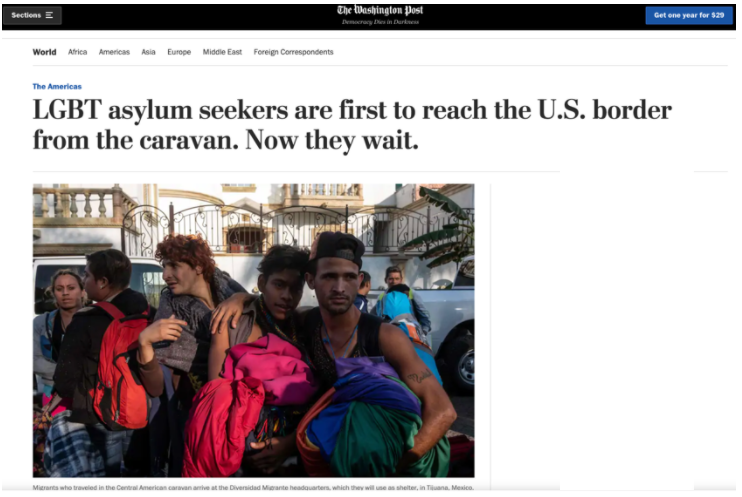
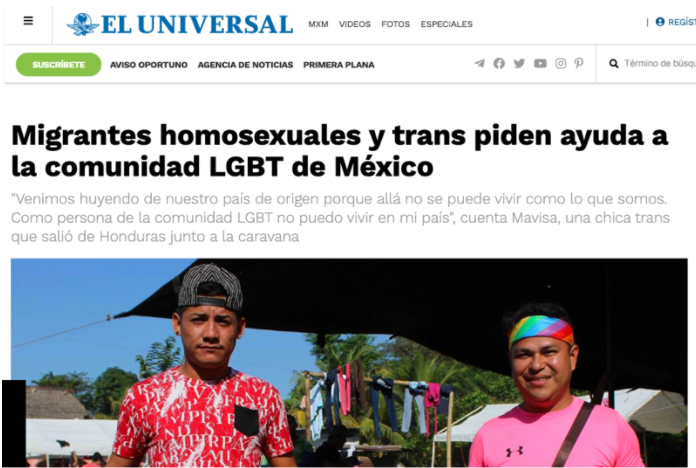
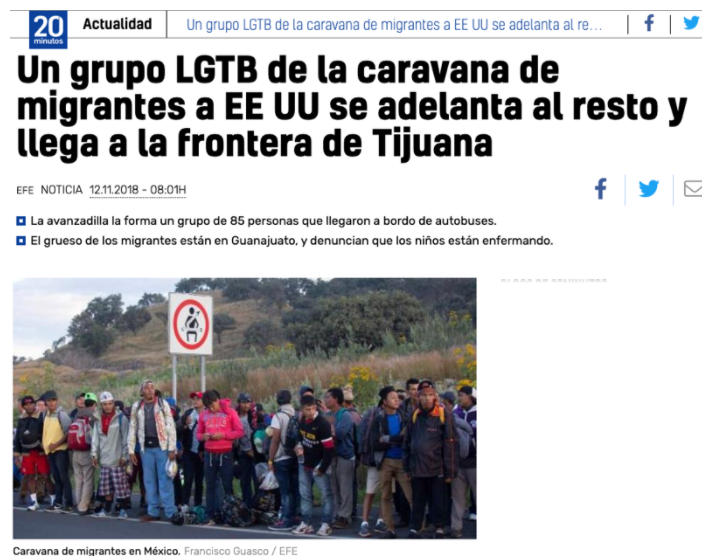
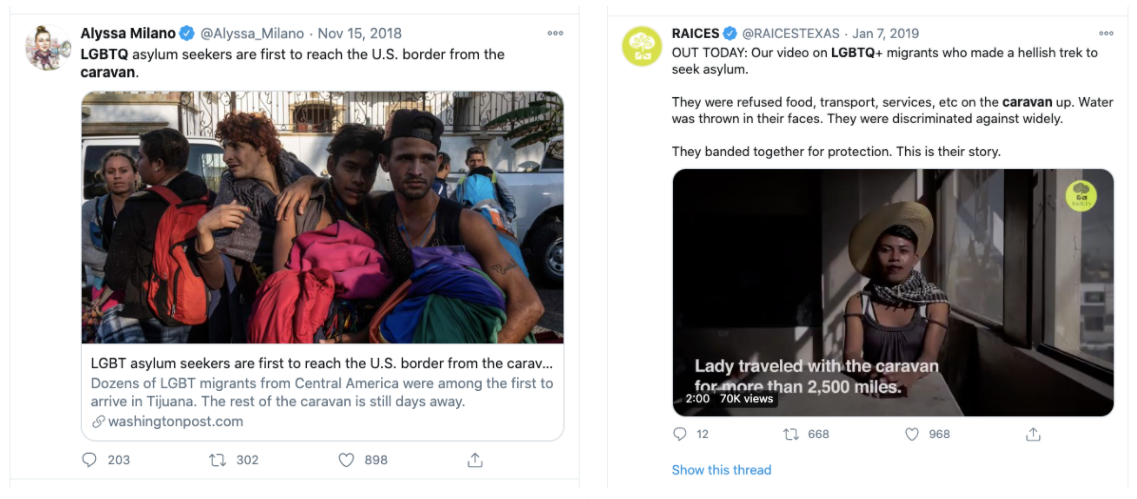

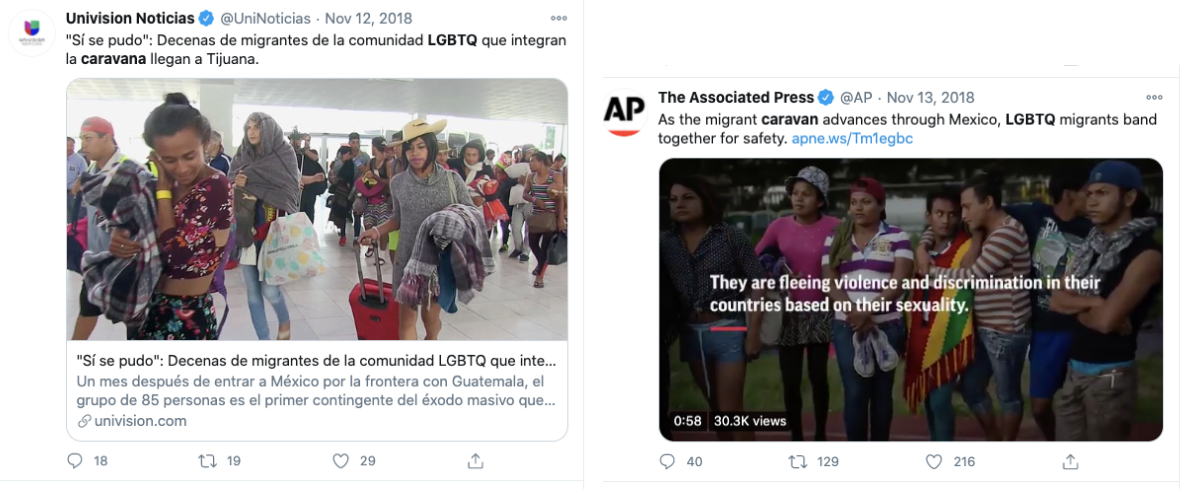
Table 1. Links to selected news articles reporting on the LGBTQI caravans between 2017 and 2019.
| Arizona Public Media | https://news.azpm.org/p/news-topical-border/2017/9/8/116373-displaced-lgbt-people-from-central-america-mexico-head-north-for-survival/ |
| BBC | https://www.bbc.com/news/world-us-canada-48404381 |
| El Informador | https://www.informador.mx/mexico/Migrantes-de-la-comunidad-gay-sufren-homofobia-en-caravanas-20190424-0072.html |
| El Universal | https://www.eluniversal.com.mx/estados/migrantes-homosexuales-y-trans-piden-ayuda-comunidad-lgbt |
| Human Rights Watch | https://www.hrw.org/report/2020/10/07/every-day-i-live-fear/violence-and-discrimination-against-lgbt-people-el-salvador |
| Nodal | https://www.nodal.am/2018/11/las-bodas-de-arcoiris-en-la-caravana-migrante-que-cruza-por-mexico-hacia-eeuu/ |
| The Objective | https://theobjective.com/further/caravana-migrante-lgtb-discriminacion |
| The Washington Blade | https://www.washingtonblade.com/2018/11/14/migrantes-lgbti-llegaron-a-la-frontera-de-eeuu/ |
| The Washington Post | https://www.washingtonpost.com/world/the_americas/the-first-caravan-migrants-arrive-at-the-us-border-and-begin-the-waiting-game/2018/11/13/ceef3844-e6b7-11e8-8449-1ff263609a31_story.html |
| Transgender Law Center | https://transgenderlawcenter.org/archives/14085 |
| Center for American Progress | https://www.americanprogress.org/issues/lgbtq-rights/reports/2016/10/26/291115/ice-officers-overwhelmingly-use-their-discretion-to-detain-lgbt-immigrants/ |
| Telemundo | https://www.telemundo.com/noticias/noticias-telemundo/migrantes-homosexuales-y-transgenero-denuncian-abusos-y-acoso-en-centro-de-ice-en-nuevo-tmna3136357 |
| The New Humanitarian | https://www.thenewhumanitarian.org/news-feature/2020/08/13/film-Mexico-US-asylum-shutdown-LGBTQ-danger |
| The Washington Blade | https://www.washingtonblade.com/2020/05/27/video-interview-with-tijuana-lgbtq-migrant-shelter-representative/ |
| Transgender Law Center | https://www.youtube.com/watch?v=4Y4JS1eKWdg |
| Vice Español | https://www.youtube.com/watch?v=g68XyWwLqf8 |
| Vice Life | https://www.youtube.com/watch?v=km5Yc9LuRsg |
| Blogs | |
| Letters for Liberation | https://www.tqpueblo.org/lettersforliberation-from-la-palma |
| Cristianos Gay | https://www.cristianosgays.com/tags/caravana-migrantes-hondurenos/ |
| Waging NonViolence | https://wagingnonviolence.org/2017/08/trans-gay-migrant-caravan-rainbow-16/ |
| Rolling Stone | https://www.rollingstone.com/culture/culture-news/lgbtq-asylum-migrant-caravan-gay-trans-border-756233/ |
The practices of resistance were beyond posting their journey on social media. Some caravan members got married or performed symbolic weddings in Tijuana that were widely covered by the press in 2018 (https://www.nbcnews.com/news/latino/dream-come-true-lgbtq-couples-migrant-caravan-marry-seeking-asylum-n938051).
Borges (2017) mentions that "LGBTQ imaginings of community are essential in creating survival strategies from displacement. Such imaginings may mean finding home with family but also with other transnational migrants and LGBTQ individuals. They engage in making new affective spaces based on collective experiences of surviving systemic violence, including racism, exploitation, xenophobia, anti-LGBTQ sentiments and policies, sexism, and classism" (Borges, 2017, p xvi, xvii).
It is important to note that media attention was temporal, especially months before the 2018 US midterm election. After the election, the media directed its attention elsewhere. An analysis of the on-air use of the word "caravan" by three major cable news networks (MSNBC, CNN, and Fox) reveals a significant drop in mentions after the US midterms (Quartz, 2018). Figure 3 includes two graphics showing how the word "caravan" dropped from more than 600 mentions on October 23, 2018, to less than 150 on November 13, 2018. After the 2018 midterms, the LGBTQI migrants disappeared from the media.
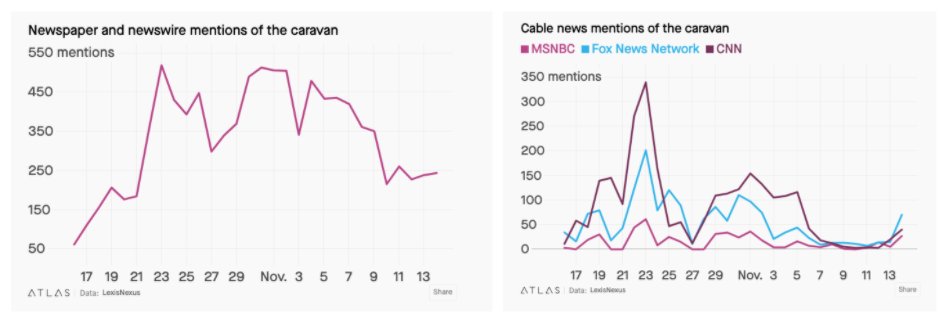
Figure 3. Number of mentions of the word “caravan” before and after the 2018 US midterm elections. Source: Quartz, 2018
Queer migrants that successfully applied for asylum waited for months to be processed. Before the US enacted the third country asylum rule in 2019, asylum seekers could spend months in detention centers. In those detention centers, LGBTQI individuals are particularly vulnerable. There are several reports about the abuses suffered by LGBTQI members in those centers (https://www.telemundo.com/noticias/noticias-telemundo/migrantes-homosexuales-y-transgenero-denuncian-abusos-y-acoso-en-centro-de-ice-en-nuevo-tmna3136357).
Institutional violence is present in the US migration system. LGBTQI people need to demonstrate who they are by providing proof of their queer relationships and abuse suffered, which could be hard to prove. After the US government accepted Arco Iris 17's asylum petition, the border officers separated the group. The officers took the eleven transgender women to Ciboa County Detention Center in New Mexico. The six gay men went to the Otero County Prison Facility, where they suffered abuses from migration officials. As of 2020, the border officer released on parole ten of the eleven transgender women – one of them voluntarily asked for her deportation. As for the gay men, the border officers deported them after several months in detention (Taracena, 2018). The transgender women from Arco Iris 17 and, in general, LGBTQI refugees face new challenges within the US. The non-profit Trans Queer Pueblo has reported that LGBTQI people, some undocumented, face difficulties finding housing and job.
Queer migrants, visibilized by the media and invisibilized by the state, have found new ways to claim their right to self-determination. Non-profit organizations and other allies keep their eyes on them. The act itself of surviving the violence in their homeland is a form of resistance. Tarecena mentions, "The act of leaving to preserve their lives, as well as sharing their experiences with outsiders, are both acts of agency and resistance" (Taracena, 2018, p 41).
Conclusions
People have migrated since time immemorial, either fleeing natural disasters or political regimes but always pursuing a better life for themselves and their families. Although migrants are entitled to the same human rights protections as all individuals, the US and Mexico have tightened their immigration policies. By criminalizing undocumented migration, Mexico and the US undermine the human right to migrate, defined in the UN International Bill of Human Rights. All Central American migrants who journey through Mexico to reach the US suffer violations of their human rights.
LGBTQI migrants also suffer discrimination just because of who they are. Queer people traveling with other migrant caravans face additional risks, including discrimination and harassment from homophobic government officials and other migrants. Among them, transgender women experience higher rates of violence and discrimination. Queer Central American migrants are caught in an endless chain of violence in their home countries during their journey through Mexico and their asylum process in the US. Vulnerable groups like LGBTQI have carried out visibilization strategies while traveling through Mexico as a way to make their voices heard.
Answering the first question I posed in the introduction: How successful have Central American LGBTQI migrants' visibility strategies been? I found that their strategy successfully captured the media's attention, which, in turn, helped them get assistance from law firms, shelters, and other organizations. The downside is that the media attention was short-lived and politically oriented to the point that the caravans practically disappeared from the media after several months. Also, it fell short when challenging the US immigration system.
Central American Queer migrants have an ally in the press and social media, empowering them and raising awareness of the violence. The LGBTQI communities are fighting for their rights and using the media to make themselves visible. However, not all the Queer caravans got the same media attention as the first – Arcoíris 17. The caravans disappeared from the press, newscasts, and social media platforms right after the 2018 midterm elections. The media and politicians used immigration as a token to get attention and votes. Once the LGBTQI migrants got to the US-Mexico border, the press stopped playing a pivotal role. The US immigration legal system is a challenge for the LGBTQI community seeking asylum and the organizations that are supporting their cause. As I mentioned, not all asylum requests from the LGBTQI caravans were successful. It seems like transgender people were more successful than gay men. It is important to note that I didn't find much information about lesbian migrants or people who identified as bisexual or intersex. Data about LGBTQI migration is hard to find.
Answering the second question, Who were the key players in mobilizing and helping Central American LGBTQI migrants? I found that empowered by their own stories, LGBTQI people were able to contact organizations willing to help them legally and financially. The support of organizations, shelters, and public kitchens was critical to the well-being of the groups that, together, have ventured across Mexico to reach the US border. The media was crucial to expanding the first LGBTQI caravan voices but not so much in the caravans that followed suit.
In general, I found visibility itself does not change society's attitudes towards LGBTQI people or destigmatize queer identities. Institutions in Central America, Mexico, and the US need to change policies reinforcing violence against LGBTQI members. The leadership role that members of the LGBTQI caravans took is undoubtedly essential. The coalitions and alliances the LGBTQI caravan members established during their journey through Mexico were crucial. Political possibilities expand when minority communities are empowered.
References
- Agarwal, Kritika, 2016. Queer Migrations: A Perspective Quick Study. Retrieved on November 28, 2020 from https://www.historians.org/publications-and-directories/perspectives-on-history/march-2016/queer-migrations-a-perspectives-quick-study
- Amnesty International. 2017. Report 2016/2017. Retrieved on November 28, 2020 from https://www.amnesty.org/download/Documents/POL1048002017ENGLISH.PDF
- Autumn, Melissa. 2014. Documenting the undocumented: Toward a queer politics of no borders White McGill University, Canada
- BBC. 2019. Rainbow Caravan. The Long Journey to LGBT Freedom by Vicky Baker. https://www.bbc.com/news/world-us-canada-48404381
- Borges, Sandibel.2017. Queer Migrations: LGBTQ Migrant Lantinx Women Re-Creating Home(s). UC Santa Barbara. Retrieved on November 20, 2020 from https://escholarship.org/uc/item/6h28d7gq
- Chavez, Karma R. 2013. Queer Migration Politics. Activist Rhetoric and Coalitional Possibilities
- Eubanks. 2012. The Harvey Milk Interviews: In His Own Words. Edited by Vince Emery. Retrieved on November 28, 2020 from https://www.lambdaliterary.org/2012/08/the-harvey-milk-interviews-in-his-own-words-edited-by-vince-emery/
- Grandin, Gregg, Deborah T. Levenson, Elizabeth Oglesby. 2011. The Guatemal Reader. History, Culture, Politics. Duke University Press.
- International Organization for Migration. 2020. The World Migration Report 2020. Retrieved on November 30, 2020 from https://www.un.org/sites/un2.un.org/files/wmr_2020.pdf
- Kim, Eunsong, 2016. The Politics of Visibility. Retrieved on November 20, 2020 from https://www.disruptingdh.com/politics-of-visibility/
- Lewis, Rachel A. 2019. LGTBQ Migration Crises in The Oxford Handbook of Migration Crises, pp 677-691
- Luibhéid, Eithne and Lionel Cantú Jr. (editors). 2005. Queer Migrations. Sexuality, U.S. Citizenship, and Border Crossings
- Luibhéid, Eithne and Karma R. Chaves (editors). 2020. Queer and Trans Migrations. Dynamics of Illegalization, Detention, and Deportation
- Moore, Lisa Jean, and Monica Casper. 2009. Missing Bodies : The Politics of Visibility, New York University Press.
- National Immigration Forum. 2019. Retrieved on November 28, 2020 from https://immigrationforum.org/article/push-or-pull-factors-what-drives-central-american-migrants-to-the-u-s/
- Pastorfield-Li, Pastoreli, Joel Carter, Ashley Moore, Lucia Montes. 2020. Caravanas de migrantes en México in La Iniciativa de Políticas Públicas de Centroamérica y México. Strauss Center.
- Quartz. 2018. The media coverage of the migrant caravan nearly stopped after the US midterms. Retrieved on November 20, 2020 from https://qz.com/1467663/the-media-coverage-of-the-migrant-caravan-nearly-stopped-after-the-us-midterms/
- Phillip M. Ayoub & Lauren Bauman (2019) Migration and queer mobilisations: how migration facilitates cross-border LGBTQ activism, Journal of Ethnic and Migration Studies, 45:15, 2758-2778, DOI: 10.1080/1369183X.2018.1497955
- Rollingstone. 2018. LGBTQ Asylum Seekers First Migrant Caravan Group to Arrive at US Border by Amelia McDonell-Parry https://www.rollingstone.com/culture/culture-news/lgbtq-asylum-migrant-caravan-gay-trans-border-756233/
- Taracena, María Inés. 2018. La Caravana de la Resistencia: Narratives of Survival and Displacement from LGBTQI Central American Asylum Seekers. Master Thesis, University of Arizona.
- The Objective. 2018. La Caravana Migrante LGTB. Discriminación dentro de la discriminación. https://theobjective.com/further/caravana-migrante-lgtb-discriminacion
- Torre Cantalpiedra, Eduardo. 2019. Políticas migratorias y de protección internacional tras el paso de las caravanas por México. El Colegio de la Frontera Norte. Conacyt.
- United Nations. International Organization for Migration. 2018. Migration and the 2030 Agenda. Retrieved on November 28, 2020 from https://gmdac.iom.int/sites/default/files/papers/en_sdg_web.pdf
- United Nations. 1990. International Convention on the Protection of the Rights of All Migrant Workers and Members of Their Families.
- Vogt, Wendy Alexandra. 2012. Ruptured journeys, ruptured lives: Central American migration, transnational violence, and hope in southern Mexico. PHD Thesis. University of Arizona.
- Vogt, Wendy Alexandra. 2018. Lives in Transit. Violence and Intimacy on The Migrant Journey. University of California Press.