Traditional Knowledge Applications on Small-Scale Fisheries Management
According to the Food and Agriculture Organization of the United Nations (FAO), nearly 90% of the world's marine fish stocks are now fully exploited, overexploited, or depleted (FAO, 2018). Marine fish stocks are an essential part of the world food system – 17% of all protein consumed comes from fisheries (FAO, 2018). Fishing activity is even more critical in developing countries like Mexico, where some communities, including Indigenous communities, depend on it for their subsistence. The Cucapá people from the Colorado River delta in northern Mexico is just one of several Indigenous communities affected by the depletion of the fishing stock.
Trying to reverse this trend, the Mexican Government enacted temporary and permanent species-specific fishing bans that affected the Cucapá's livelihoods. In 1993, the Mexican Environment Secretariat established the Upper Gulf of California and Colorado River Delta Biosphere Reserve that prohibited fishing activities (Figure 1). The Cucapá fishers, most of whom are women, have been fighting for the state to recognize their ancestral territorial rights, including respecting their traditional food systems. Their fight intensified when the catch area used by generations of Cucapás became a protected zone under the law.
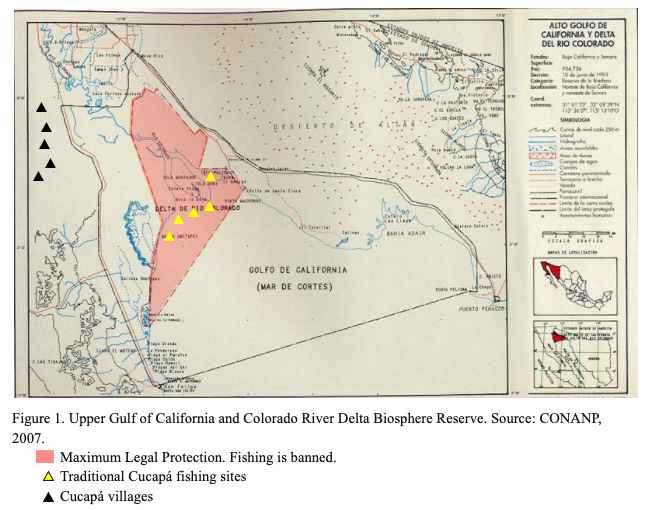
I will explore the fishing practices carried out by the Cucapá that can help implement better fishing practices in the Colorado River Delta in Mexico. I hope to contribute to understanding how traditional knowledge can help preserve ecosystems, reduce overexploited fisheries, improve small-scale fishing systems, and strengthen food security.
Research Sources
Butler et al. (2012) apply Traditional Ecological Knowledge (TEK) in four fisheries of the Torres Strait between the state of Queensland, Australia, and Western Province, Papua New Guinea. Fisheries included turtle, dugong, lobster, and hand collectibles, i.e., bêche-de-mer and trochus. Authors conclude that the application of both TEK and SMK – Science and Management Knowledge, "potentially enhances the resilience of social-ecological systems by providing a diversity of knowledge for problem-solving and related cross-scale and adaptive governance networks" (Butler et al., 2012, p 13). Raymond-Yacobyan et al. (2017) study the incorporation of TEK in Alaskan fisheries. The authors conclude that TEK "can offer important information and perspectives for fisheries science, management, and policy. [Its use] could reduce the impact of management decisions on subsistence communities, increase equity and fairness in management processes, and increase the understanding of marine ecosystems and the role of humans in them" (Raymond-Yacobyan et al., 2017, p 139). Basurto (2005) and Basurto and Coleman (2010) analyze the small-scale fisheries' traditional practices of the Seri Indigenous people in northwestern Mexico. Basurto and Coleman conclude that some management and governance efforts established by the Seri helped control fishing efforts of fisheries they share with non-indigenous communities. Based on a study carried out in Roviana Lagoon, on the island of New Georgia, Western Province, Solomon Islands, Hamilton and Walter (1999) argue that traditional knowledge is essential in designing scientific research.
Building on what I understood from Butler et al. (2012), Raymond-Yacobyan et al. (2017), Basurto (2005), Basurto and Coleman (2010), and Hamilton and Walter (1999), I will explore four ways traditional knowledge can improve small-scale fisheries: 1.) Fisheries ecology, 2.) Fisheries assessment, 3.) Fisheries management, and 4.) Fisheries research design. I will build on the fishing practices carried out by the Cucapá that have been documented by Carbajal Lopez (2019) and Navarro Smith et al. (2014).
Fisheries Ecology
Local fishers, including Indigenous fishers, have direct contact with the marine and riparian ecosystems where they fish. The Cucapá people have been fishing for centuries in the Colorado River delta and the upper Gulf of California. They possess critical local knowledge of species' ecology and behavior and habitat conditions – they know where and when to fish (Carbajal Lopez, 2019). The Cucapás can identify migration routes and the habitats where target species feed, spawn and recruit, connecting essential habitats within the seascape. Cucapás can also predict trends and fish schools' movements depending on the water temperature and tides' change. The Cucapás have experienced natural and artificial river droughts – due to the building of several dams on the US side of the Colorado River – and other environmental phenomena that continuously change the seascape where they fish (Navarro Smith et al., 2014). They are continually adapting their fishing techniques and adopting new tools.
Scientists have focused on collecting data about corvina (Cynoscion othonopterus), leaving aside other species relevant to the ecosystem. In this regard, the Cucapás could help understand the Colorado River delta ecosystem by exploring relational values and species interconnectivity. The Cucapás' expertise is unique because they can provide knowledge derived from long-term, practical, in situ observations and engagement with the environment (Carbajal Lopez, 2019). Traditional knowledge offers a broader understanding of fisheries ecology by integrating sociocultural aspects into the ecosystem equation. Cucapá fisheries' livelihoods combine rituals and celebrations with harvesting seasons, fish behavior, and biology knowledge. Policy and management, human impacts, and environmental change are also part of their traditional knowledge.
Fisheries Assessment
Data collection – quantitative and qualitative – is the first step to understanding fisheries ecology. Datasets originated in Indigenous knowledge could inform western-based systems that model and predict scenarios useful for fisheries assessment and management. Acquiring target specie's distribution, seasonality, and abundance data are vital where information is limited, scarce, or needs updating. (Raymond-Yacobyan et al., 2017). The Mexican Government and scientists could use the Cucapá's traditional knowledge to obtain fishing stock data for fisheries management.
Scientists rely on historical data to feed the models that predict future trends, and the local fishers are the ones who possess that information, passing it from generation to generation. Place-based, fine-scale spatial and temporal data owned by the Cucapás provide long-term baselines for stock assessments, safe biological limits, and identification of essential habitats, including spawning and nursery areas, refuge and feeding zones, and others. All this data is crucial for managing marine species populations and understanding their spatial and seasonal movements, and it is precisely the local fishers who best know these areas (Carbajal Lopez (2019).
Local and Indigenous communities often carry out customary monitoring programs that can also inform on the impacts of activities in their ecosystems, including subsistence harvests, commercial harvests, and management actions. Similar to other Indigenous communities, interspecies connectivity is present in the Cucapás cosmovision, which could help scientists understand and valuate the marine ecosystem as a whole.
Fisheries Management
In terms of fisheries management, traditional knowledge could promote an inclusive, more integrated vision of human and nature interactions. This vision involves social, ecological, and economic factors, including fishers designing and applying fisheries management plans (Carbajal Lopez, 2019).
Unlike established fisheries management plans - a system that mainly includes quantitative data such as the status of fishing stocks and information on the fleet - Cucapás could help design management techniques, define customary management systems, and establish an intercultural and inter-institutional government. Local users' involvement is vital under this new management form. Local fishers must participate in all phases, from data collection, fisheries assessment, and plan design and implementation.
Incorporating traditional knowledge can lead to more informed, equitable, and effective policy and management practices. An open and transparent process could strengthen and empower local fishers and improve ecosystem-based fisheries management frameworks. (Raymond-Yacobyan et al., 2017).
It is important to note that fisheries management plans cannot respond to all fishers. Fishers are different regarding if they are Indigenous, if they are local but not Indigenous, or if they are seasonal fishers. Fishers also differ if they fish in one place or use multiple fishing sites, the type of gear they use, and others. Because traditional knowledge offers complex ecological information obtained through generations of observation and experience, it is culturally structured and hard to replicate out of the local context. (Hamilton and Walter, 1999). Therefore, fisheries management is like a custom made suit.
Fisheries Research Design
Often, scientists and professionals trained in fisheries management do not have the skills to interpret the complex cultural system that integrates traditional knowledge and practices. Nevertheless, traditional knowledge systems contain relevant information for research scientists. Traditional knowledge not only offers baseline information on local ecologies, including information on what is present in the local ecosystems and its temporal and spatial patterning but also offers sociocultural aspects of the knowledge holders. (Hamilton and Walter, 1999)
Because traditional knowledge systems are culturally structured, there is a risk in extracting information from one system and applying it to another. For example, a fisheries practitioner cannot export Cucapá fisheries values and management initiatives to the Seri community's practices described by Basurto and Coleman (2010). Consequently, Hamilton and Walter (1999) propose that "research scientists working with TEK should attempt to develop a holistic understanding of those systems, so as to understand the context of the information [local people] hold" (Hamilton and Walter, 1999, p 23).
Traditional knowledge is a compilation of knowledge passed from generation to generation. It reflects the unique interactions between human communities and their environment that scientific models do not possess. According to Hamilton and Walter (1999), when traditional knowledge is appropriately understood, there is a potential for ecosystem managers to develop innovative research projects.
Conclusions
Traditional knowledge holders could offer the experience, ancient wisdom, and direct contact with changing ecosystems that fisheries managers and practitioners do not have or are just beginning to develop. Hamilton and Walter (1999) mention that even though "Indigenous knowledge is an enormously valuable resource base," often, research scientists have "treated [traditional knowledge] in a far too casual manner" (Hamilton and Walter, 1999, p 23).
Authors Butler et al. (2012), Raymond-Yacobyan et al. (2017), Basurto (2005), Basurto and Coleman (2010), and Hamilton and Walter (1999) give us several examples of traditional and local knowledge that have already made substantial contributions to understanding marine environments and fisheries management as an ecosystem.
I mentioned that an integrated fisheries management plan is like a custom made suit. Thus, the Cucapás, scientists, and fisheries practitioners need to work together to define a management plan that best suits the users. Some examples of knowledge the Cucapá people – and Indigenous and local communities in general – could provide are:
- Long-term and historical data
- Ecosystem perspectives
- Reconceptualization of human-environment relationships
- Species connectivity
- Interconnections between fisheries and environmental change
- Hundreds of year of fisheries management
- Others that I may not have identified
The Cucapá have been living in the Colorado River delta for thousands of years. They have adapted their fishing techniques and transmitted them for generations. Scientists and practitioners still have a lot to learn from the Cucapá's traditional fishing knowledge. A more holistic, cross-disciplinary approach that benefits ecosystem users and the environment is necessary.
References
- Basurto, Xavier. 2005. How Locally Designed Access and Use Controls Can Prevent the Tragedy of the Commons in a Mexican Small-Scale Fishing Community. In Society & Natural Resources: An International Journal, 18:7, 643-659, DOI: 10.1080/08941920590959631
- Basurto, Xavier, and Eric Coleman. 2010. Institutional and ecological interplay for successful self-governance of community-based fisheries. In Ecological Economics 69 (2010) 1094–1103.
- Butler, J. R. A., A. Tawake, T. Skewes, L. Tawake, and V. McGrath. 2012. Integrating traditional ecological knowledge and fisheries management in the Torres Strait, Australia: the catalytic role of turtles and dugong as cultural keystone species. Ecology and Society 17(4): 34. http://dx.doi.org/10.5751/ES-05165-170434
- Carbajal Lopez, Alberto. 2019. Conocimiento ecológico tradicional en el manejo de pesquerías artesanales. Ciencia y Desarrollo. Retrieved on November 27, 2020, from https://www.cyd.conacyt.gob.mx/?p=articulo&id=228
- FAO, Food and Agriculture Organization of the United Nations. 2018. Article - 90% of fish stocks are used up – fisheries subsidies must stop. Retrieved on November 27, 2020, from https://unctad.org/news/90-fish-stocks-are-used-fisheries-subsidies-must-stop
- Hamilton, Richard, and Richard Walter. 1999. Indigenous ecological knowledge and its role in fisheries research design: A case study from Roviana Lagoon, Western Province, Solomon Islands. SPC Traditional Marine Resource Management and Knowledge Information Bulletin #11 – September 1999, 13-25.
- Navarro Smith, A., Y. Bravo Espinosa, and C. López-Sagástegui. 2014. Derechos colectivos y consulta previa: territorio cucapá y recursos pesqueros en Baja California, México. Revista Colombiana de Sociología, 37(2), 43-64.
- Raymond-Yakoubiana, Julie, Brenden Raymond-Yakoubian, and Catherine Moncrieff. 2017. The incorporation of traditional knowledge into Alaska federal fisheries management. Marine Policy 78, 132–142. http://dx.doi.org/10.1016/j.marpol.2016.12.024